


What are you feeling right now? Are you curious? Hopeful that you’ll learn something about yourself? Emotions like these (and many others) give us information about what we’re experiencing and help us know how to react.
Emotions are a fundamental aspect of the human experience, they affect how we think, feel, and act, providing signals about our environment and internal states. Understanding your emotions is crucial for making informed decisions and building healthy relationships.
Emotions are complex reactions that engage both the mind and body. They are responses to internal or external stimuli, involving physiological arousal, expressive behaviors, and conscious experience. In everyday terms; emotions are feelings triggered by people, events, or thoughts. For example, seeing a friend can make you feel happy while thinking about an exam or presentation at work might make you nervous.
Emotions are short-lived, with scientific evidence suggesting they last approximately 90 seconds if left to run their natural course. Feelings, on the other hand, are our awareness and interpretation of those emotional responses.
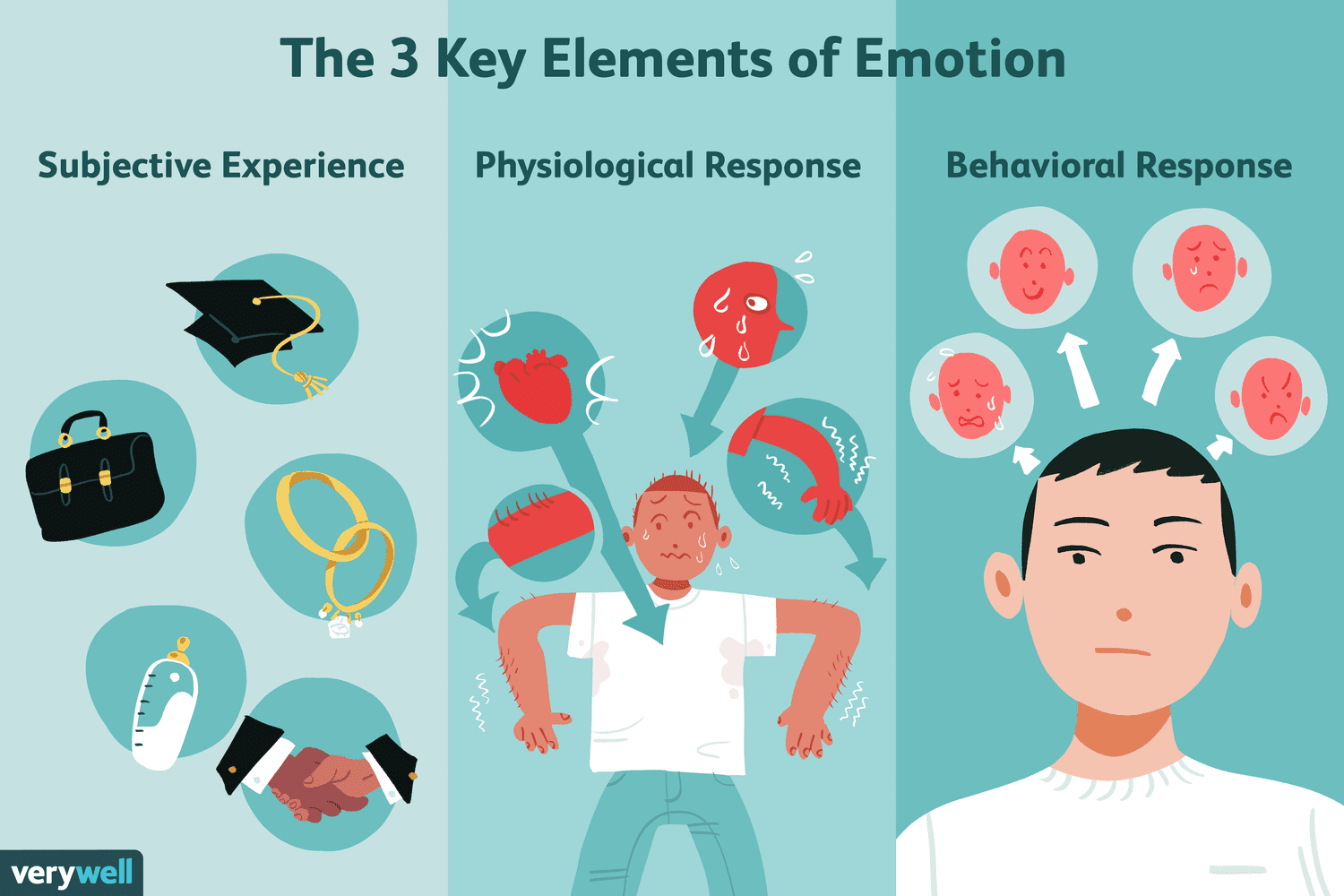
Image credit: Verywellmind.com
| 👤 Subjective Experience: |
| This is how we personally experience emotions. For example, two people might both feel happy, but one might describe it as feeling “warm and fuzzy” while the other might say it feels like “floating on air.” |
| 🫀Physiological Response: |
| These are the changes that happen in our bodies when we experience an emotion. For instance, when you’re scared, your heart might race, your palms might sweat, and you might breathe faster. These physical changes are your body’s way of preparing to deal with the situation. |
| 🗣️ Behavioural Response: |
| This is how we express emotions through our actions. When you’re happy, you might smile or laugh. When you’re angry, you might frown or raise your voice. Our behavioural responses help communicate our feelings to others. |
From the time we’re born, we sense and react to emotions. Infants show emotions through facial expressions and actions like laughing or crying. As we grow older, we learn to identify and name our emotions, a skill known as emotional awareness.
This helps us understand what we need and want, build better relationships, and resolve conflicts more effectively. Emotional awareness is the first step toward building emotional intelligence, which can help us succeed in almost every aspect of our lives.
For those interested in deeper theoretical understanding, here are some recommended readings:
👉 See you in the next lesson where we’ll unpack the function and impact of our emotions.


